
Location : Home > News >
The magnificent French marbles from the time of the Sun King Louis XIV
( Date: 2025/11/17 9:50:45 )
Update: Françoise Heidet-Naudet will give a lecture on this topic at the Rocalia trade fair in Lyon on December 03, 2025.
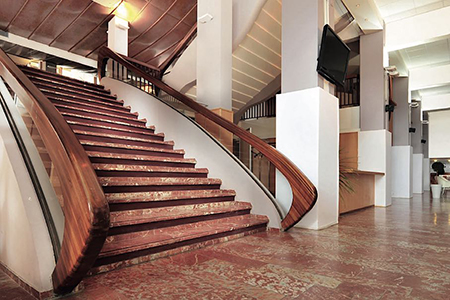
Magnificent marble from France? Some may wonder if such a thing really exists, after all, other countries are better known for exotic stone varieties. Nevertheless, France (and Belgium, next door) in particular has such varieties, and one can safely emphasize: has (not: had), because many of the quarries are still in operation, but can (currently) only supply small quantities.
Françoise Heidet-Naudet, natural stone fan and France enthusiast, has published a book on the subject. The title is “Marbres français. Voyage en Polychromie“ (Marble from France – Journey into Polychromy). In it, the marketing expert presents over 50 such varieties.
The 190-page book with excellent photo quality is only available in French, of course, but we still recommend it to our international readership: You can also use it purely as a picture book, and then, with its incredible photos of works of art, churches, or the Palace of Versailles, it whets the appetite for what previous experts have done with the material.
And there’s OCR software as an extension to standard browser programs, which makes photos of printed text readable without typing through photo or scan.
The author also shows a way how national quarries can compete with imports from around the world: She explicitly emphasizes that the types she presents are only mined in small quantities and are therefore expensive, thus only accessible to people with the most exclusive tastes.
The author is a trained marketing and communications specialist and has also worked for the Burgundy Stone Association. This is where the classic limestones associated with France come from, which are mined in large quantities and are also in demand.
For her book, however, Françoise Heidet-Naudet has turned away from these “industrial quarries,“ as she uncritically calls them, and instead focuses on “marble quarries.“ By this, she means the perhaps 80 exclusive varieties that are still being mined or whose quarries could be revived in the short term.
The geological section of the book on the formation of marble is short and understandable even for the layperson.
She takes her first steps into the narrative when she addresses the ancient methods of mining, transport, and processing. The theme of inland canals emerges here, comparable to the Navigli system in Italy. In France, the colorful stones from the Languedoc were transported via the Canal du Midi to the Atlantic, then by bigger ships to Le Havre, and from there up the Seine to Paris. In Italy, the white marble from the regal quarries on Lago Maggiore, at the rim of the Alps, was transported via inland canals to Milan for the construction of the incomparable cathedral.
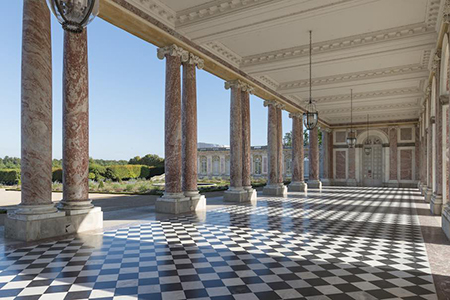
The colorful French stones experienced their heyday under Louis XIV, who pursued a veritable “marble policy“ and had representatives of his administration select the best pieces for his palace in Versailles (from 1661).
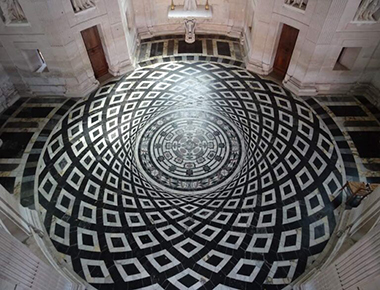
The Roman occupiers of what was then Gaul first noticed the colorful varieties. Françoise Heidet-Naudet notes: “The villae, vast agricultural estates, were often endowed with a level of luxury that the rulers of the later Kingdom of France never regained, even at the height of their glory.“ Mosaics from that period can still be admired today.
While the “Marble Renaissance“ (Heidet-Naudet), originating in Italy, revived the style of antiquity from the 15th to 17th centuries, France also acquired this taste about 100 years later with Kings Francis I and Henry IV.
The author describes the second half of the 17th and the 18th centuries as “the golden age of French marble,“ with architecture characterized by clean lines and clear forms as well as rich colors: “The marble decorations ubiquitous in Versailles are an expression of this very special architectural style.“
With Napoleon III and Baron Haussmann’s transformation of Paris before 1900, there was a new boom for marble and also for limestone from, what she calls, industrial quarries.
The author’s references to Stéphane Dervillé, Édouard Empain, and Nicolas Gauthier, among the most influential men of their time and either marble entrepreneurs or even starting out as stonemasons, make you want to read on elsewhere.
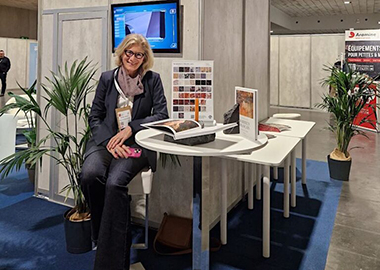
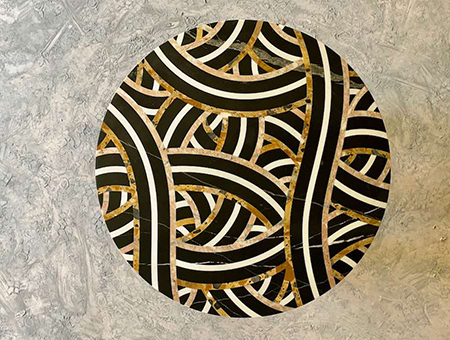
In approximately 190 pages, the author presents the types she is so passionate about. Each type is presented with a close-up and examples of its use in architecture, design, and art. As for the examples of product design, these are objects that fulfill their function, not simply display unusual shapes.
Finally, she rarely shows photos of quarries, and when she does, they are of exceptional landscapes rather than of the destruction of mountains.
Finally, there are short portraits of ten people who are currently bringing the beauty of stone to the public in architecture, design, art, restoration, and stonemasonry.
We would like to mention some of the contributors to the book, who, alongside the author, contribute to its exceptional quality:
* Artistic Director: Séverine Chupin, Les Pistoleros Agency
* Editor: Frédérick Vigot, Editions Vial;
* Photographers: Arnaud Finistre, Clérin/Morin;
* Journalist: Philippe Bertrand;
* Geologist: Eric Marcoux.
From: stone-ideas
Latest Resources
- Construction Resources Company, LLC acqu...
- ABC: 9 in 10 construction workers in 24 ...
- Merola introduces Ritz and Victorian col...
- Panariagroup USA to unveil new collectio...
- Stonegate Tooling Expands Capacity to Se...
- Northeast Stone Fabricator Enhances Cust...
- Neolith Launches Four New Sintered Stone...
- Brazilian Stone Producers Amp Up for Xia...
- Builders identify key long-term forces s...
- Caesarstone expands porcelain offering
Previous Fair








Support Center: Tel:86-592-5959630 Fax:86-592-5959611 E-mail:info@gogostone.com skype: gogostonecom
Copyright GOGOstone.com All Rights Reserved